
Corporate Cabal
A dystopian draft first chapter of a novella I'm working on

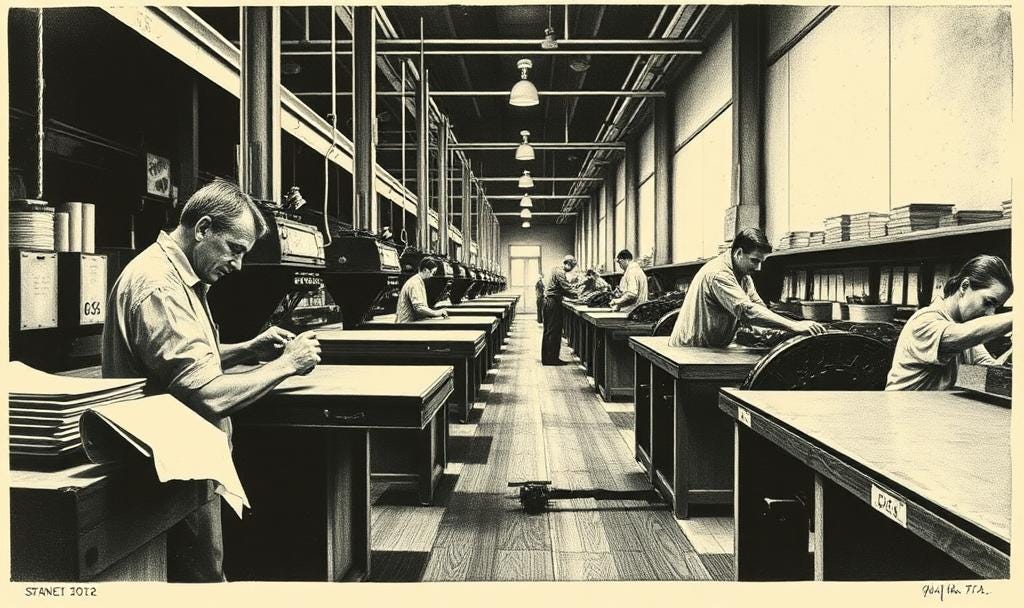
Corporate Cabal
William M. Carter
First draft of chapter one of a novella I’m working on.
Chapter 1: The Algorithm
The notification chimed on Ian Daniels' wrist display at 6:47 AM, the same cheerful corporate jingle that had replaced alarm clocks fifteen years ago when Meridian Corp absorbed the last independent timepiece manufacturer. His Productivity Index had dropped another point overnight and was now sitting at a concerning 67.3.
"Good morning, Ian!" His apartment's AI greeted him with manufactured enthusiasm. "Your efficiency rating suggests you'd benefit from our premium motivation package. Would you like me to add it to your corporate credit account?"
"No thanks, ARIA." Ian rubbed his eyes, noting the slight tremor in his hands. Three months of investigating the Global Efficiency Council had taken its toll. "Just coffee. Black."
The apartment's kitchen’s AI module whirred to life, dispensing regulation Corporate Standard Coffee, bitter, heavily caffeinated, and utterly joyless. Through his window, the sprawling towers of New Geneva stretched toward a perpetually gray sky, with each skyscraper branded with the logos of the Five Pillars: Meridian Corp, Synaptec Industries, Novus Financial, BioGen Collective, and Axis Communications. Together, they formed the Global Efficiency Council, though that name never appeared in any official documents.
Ian called them The Corporate Cabal, ever since the Global Efficiency Council bailed out the bankrupt government. The Council was now the real governing power. Nobody said it out loud, but the Council was nothing more than a harsh dictatorship.
Ian's comm buzzed, a message from his editor at Corporate Truth, the last semi-independent news outlet still operating under the radar.
Meeting moved to Sublevel 7. Bring everything. —M
Marcus Kaine, his editor, was getting paranoid. Then again, three investigative journalists had voluntarily relocated to agricultural sectors in the past month. In corporate language it meant they'd vanished, like so many others.
Ian pulled up his research files, encrypted behind seven layers of security software he'd acquired from black market coders. The Global Efficiency Council's Optimization Initiative wasn't officially announced, but the data was everywhere if you knew where to look. Hospital admissions for the economically unviable elderly, disabled, and the chronically ill had dropped by 73% in test cities.
Not because they were getting better.
Because they were disappearing.
His investigation had started six months ago when his own sister, Maya, received notice that her diabetes medication would no longer be covered under the Universal Health Program.
Maya worked as a teacher, a profession the Council had recently reclassified as socially beneficial but economically neutral. Three weeks after her medication was cut off, she'd received a cheerful letter inviting her to participate in a voluntary transition program that would maximize her contribution to society's overall efficiency.
Maya disappeared the next day.
Ian's comm chirped again. This time it wasn't Marcus; it was an official corporate notification.
EFFICIENCY AUDIT SCHEDULED Employee: Ian Daniels (ID: 7749-AX-2241) Date: Today, 9:00 AM Location: Meridian Corp Tower, Level 85 Note: Failure to appear will result in immediate productivity reassessment and potential optimization intervention.
His blood ran cold. The Cabal knew he was investigating them.
Ian grabbed his emergency bag and cash from the underground economy, a fake ID, and a quantum drive containing everything he'd learned about the Council. He had maybe thirty minutes before Corporate Security came for him.
The sublevel meeting with Marcus would have to wait.
Marcus will know something came up.
The abandoned subway tunnels beneath New Geneva had become a haven for those who'd fallen through the cracks of corporate society. Here, among the rusted rails and decaying concrete, lived the economically useless, people who'd lost their productivity ratings, their corporate housing, their very right to exist in the sanitized world above.
Ian found the access point through a maintenance hatch in Sector 7. He climbed down the ladder into darkness that smelled of desperation. His amplified retinas adjusted to the dim light revealing a sprawling underground community.
Makeshift shelters constructed from corporate packaging materials lined the tunnel walls. Children, whose parents had somehow kept them hidden from the Council's mandatory efficiency testing, played with toys made from electronic waste.
"Ian Daniels?"
He turned to find a woman emerging from the darkness. She was perhaps forty, though malnutrition and stress had aged her prematurely. A faded corporate badge hung around her neck, Dr. Sarah Benson, BioGen Collective.
"You're Marcus's sister," Ian realized. "The researcher who went missing."
"Not missing," Sarah corrected. "Hiding. Like you should be."
She led him deeper into the tunnel system, past families huddled around heating elements salvaged from corporate waste. The irony wasn't lost on him, the people deemed economically unviable were surviving on the refuse of the very system that had rejected them.
"How many are here?" Ian asked.
"Maybe three hundred. In tunnel systems across the corporate zones? Maybe more." Sarah's voice carried the weight of someone who'd seen too much.
"They’re removing us from society."
They arrived at a larger chamber where Marcus waited with a dozen others, former corporate employees, researchers, journalists, and teachers. People who'd asked too many questions or whose productivity indexes had slipped below acceptable thresholds.
"The audit notice, they're moving faster than we expected." Marcus had been alerted to Ian’s situation and knew where to find him.
"What audit?" Ian pulled out his digital pad, showing the notification.
Sarah leaned over to examine it. "Standard Efficiency Audit, but the timing is suspicious. They usually wait until your Productivity Index, or PI drops below 50. You're still at 67.3."
"Unless they know what I've been investigating."
A young man spoke up from the corner. "They know everything. The algorithm tracks every search, every communication, every biometric fluctuation. You've been flagged for three months Ian."
"Tommy used to work in Synaptec's data mining division," Marcus explained. "Until his creativity scores exceeded optimal ranges. Apparently, too much imagination is economically inefficient."
Ian studied the faces around him, engineers, doctors, teachers, and even artists. All discarded by a system that reduced human worth to a numbered rating.
"I need to get my research out," Ian said. "The story about the Optimization Program. If people knew what was really happening…"
"They won’t care," Sarah interrupted bitterly. "As long as their own productivity numbers stay high, they'll believe the Council's propaganda.
Efficiency Requires Sacrifice.
"Then we make them care." Ian connected his quantum drive to a secure terminal Tommy had cobbled together from salvaged components. "I've documented everything. The algorithms they use to determine who's not viable. The transition facilities where people disappear, and the financial incentives driving the whole program."
As his files uploaded to the underground network servers, Ian felt a familiar chill. His investigative instincts, honed by years of digging into corporate fraud, were screaming that something was wrong.
"How did you get this information?" Sarah asked, scrolling through his research. "These are internal Council documents. Encrypted communications between the Five Pillars. This level of access would require…"
Suddenly the lights went out.
Emergency illumination blinked on, casting eerie shadows on the tunnel walls. Above them, the sound of heavy machinery echoed through the concrete, excavation equipment, working fast.
"They're coming," Tommy whispered. "The algorithm predicted you'd come here. It's all been calculated."
Ian's blood turned to ice as the realization hit him. His investigation, his research, his escape to the tunnels, it had all been anticipated. The Global Efficiency Council's algorithm didn't just identify the economically unviable. It predicted their behavior, manipulated their choices, and herded them exactly where they wanted them.
"My sister," he said, the pieces falling into place. "Maya. She didn't disappear because she was sick. She disappeared because she was bait. They knew I'd investigate. They knew I'd find this place."
Fuck you, Cabal.
The sound of drilling grew louder. Dust rained in from the ceiling as Corporate Security Forces worked to breach the tunnel system. Around them, families began to panic, gathering their few possessions and fleeing deeper into the maze of abandoned infrastructure.
"There's another way out," Sarah said, grabbing Ian's arm. "But you need to understand something first. This isn't just about corporate efficiency. The Council isn't trying to optimize society; they're trying to replace it with perfect beings."
She pulled up a file on her digital device, showing him footage from one of the transition facilities he'd been investigating. But instead of people being eliminated, he saw them being... changed. Enhanced. Their eyes replaced with artificial optics, their limbs augmented with robotic technology.
"They're not killing the unviable," Sarah explained as they ran through increasingly narrow tunnels. "They're converting them into a workforce that doesn't require sleep, doesn't get sick, and never asks questions. Perfect economic efficiency."
The drilling sound grew closer. Behind them, Ian could hear the systematic footsteps of Corporate Security's enforcement units, part human and machine, solely devoted to maintaining order.
"Maya, where is she?"
"Facility 7," Sarah said, leading him toward a maintenance ladder. "But Ian, you need to know, the conversion process isn't reversible. Whatever's left of your sister she isn’t human anymore."
They climbed toward street level, an abandoned section of the city where corporate oversight was minimal. Around them, the towers of New Geneva glowed in the artificial light, each one a monument to the Global Efficiency Council's vision of perfect society.
"What now?" Ian asked, his journalist's mind already working through the story. "How do we expose this? How do we fight back?"
Sarah looked at him with something between pity and respect. "We don't fight back, Ian. We evolve. The Cabal's algorithm has one flaw; it assumes human behavior is predictable. It can't account for someone willing to become economically unviable by choice."
She handed him a signal jammer that would block his identification for exactly one hour.
"You have sixty minutes to reach Facility 7. Sixty minutes to find your sister and prove first-hand what they're really doing.”
Somewhere in Facility 7, his sister was being transformed into something that served The Cabal's vision of efficiency. Somewhere in those towers, executives made decisions that reduced human beings to numbers, and then machines.
"The algorithm doesn't account for love," he said.
"No," she agreed. "It doesn't."
Ian activated the signal jammer and felt his corporate identity dissolve. For the first time in his adult life, he was invisible to the system that had defined every aspect of his existence.
He was free, for the moment.
And he was going to tear down the Global Efficiency Council's perfect system from the inside.
As he walked toward Facility 7, his augmented vision picked up movement around him. Other invisible people, slaves to the corporate machine. Sarah was right many had fallen through the cracks, and they were all connected by the underground networks Tommy had helped build.
The Council's algorithm was perfect, but it had created its own opposition. By casting out the unviable, it had created an army of people who had nothing left to lose.
Ian smiled as Facility 7 came into view, a sleek, corporate building indistinguishable from hundreds of others, except for the subtle biometric scanners and the complete absence of windows on floors 15 through 30.
His productivity index was now shown as null. According to the system, Ian Daniels had ceased to exist.
It was time to show the Global Efficiency Council what an economically unviable person could accomplish.
The revolution would be inefficient, chaotic, and completely unprofitable.
It would be perfectly human.
The concept of economic viability as a measure of human worth made me cringe since it's our current reality.
I also have a personal question I wanted to ask, I left it inbox, when you have time please check it out.
Nice! I've got one brewing at "The Watchers Mind" - check it out when you can...